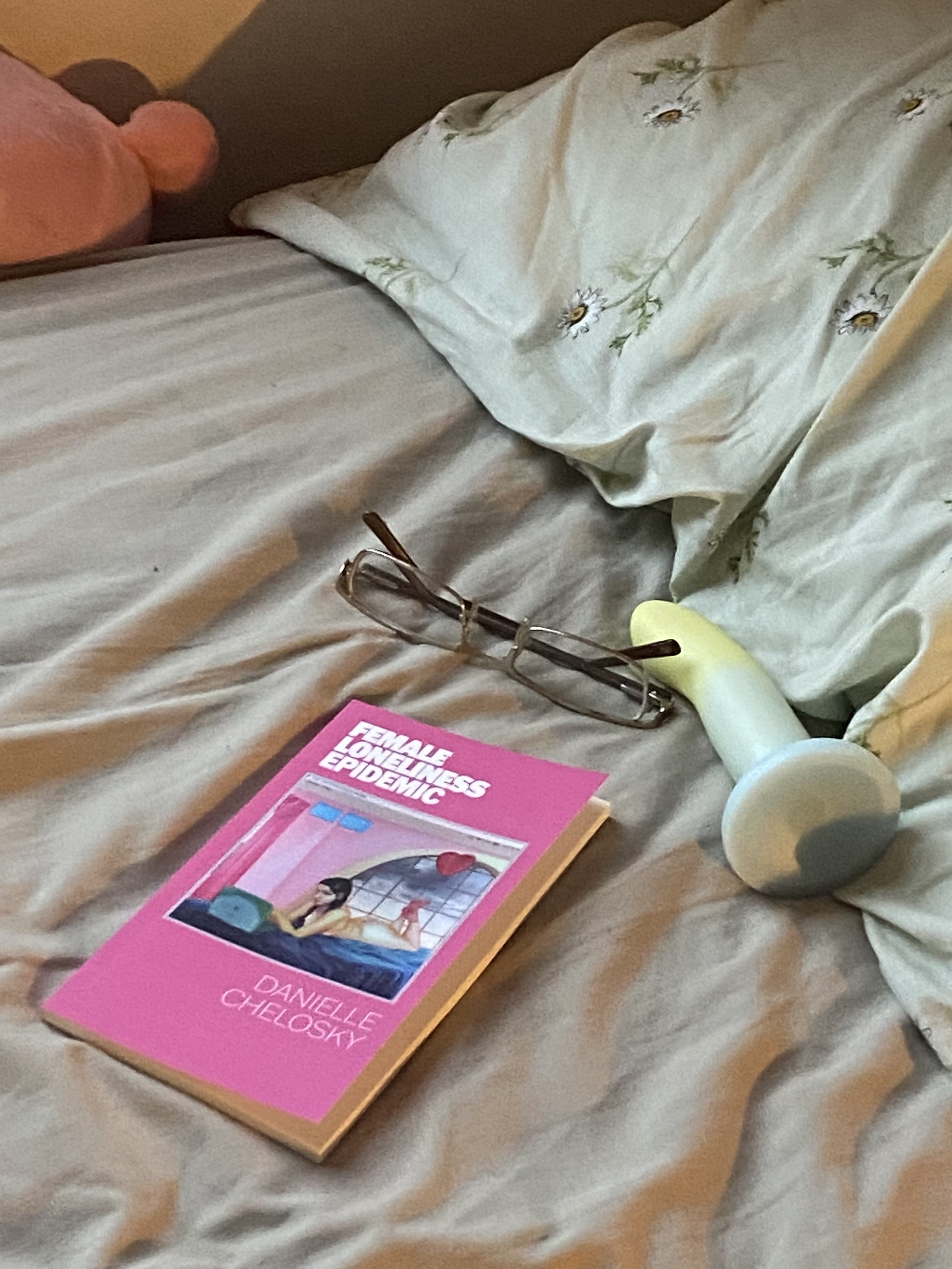
“I will give anyone the chance to see me, invite anyone into my mess in case there’s a possibility they understand.” writes Danielle Chelosky at the end of a Substack diary entry titled “i want to be a substack princess”, after she describes an encounter with an underemployed older man she entertained at a trinket boutique. This is the manhunt ethos that gives wings to Chelosky’s newest short story collection about Female Loneliness Epidemic.
Nearly each microshort tale in Female Loneliness Epidemic has doom at its epicentre: emotionally catatonic boyfriends whose eyes are glazed over from nicotine, beats, and Twitter lewd gooning; over-promulgated piss, blood, mold, and wine; repetitive jobs. Most of their narrators are moe-infused yet Breillat-ian, tripping daintily over these dooms like they’re just big chinks in the sidewalk – one time, literally (“Snuff”). There is, of course, a lot of pain. But in Chelosky’s sprightly pace, each sentence is a new moment infused with a new flitting focus. Sometimes the pain is neutered by the beginning of a new paragraph, in the same way that many girly girls, when interrupted or even anticipating interruption, will stop talking about themselves and return to brisk, safe comments about the present moment.
The prose is obviously comparable to Eve Babitz in this regard, speedy and desire-honest, but the content is even more so: the fruitless peculiarities of “the scene”, the loitering of strangers, the search for love that so often bottles into mimicry through drugs, sex, and violence. Like Babitz’s misadventured socialite narrators, Chelosky’s histrionics take up any opportunity to be left disfigured, or rather, figured into something else by someone else. From a self-flagellator being chained to the radiator by a bad-repped boo in “Bad Girl” to an alcoholic’s escapism displaced onto gamer James in “Idiot”, the narrators display a tension towards the tendency to fawn: to accede to a man’s regularities, prejudices, and oftentimes, cruelties, in order to asymptotically approach the act of becoming him in everything but the body. The fantasy of seducing cruel, misogynistic boyfriend's friend Alex, a symbol for the boyfriend’s access to power, in “Burner”, or the drug errand joyride with the narrator’s Soundcloud rapper “boy” listening to his own beats in “Cloud” show off this asymptote: what’s the difference between wanting someone and wanting to be them, especially when they’re a cruel man that seems to get away with everything? After James breaks up with the narrator in “Idiot”, she writes:
“If only the world were James’ video games. I wanted to be digital and controlled by something bigger than me.” (“Idiot”)
There’s a religious need to follow present here, but it’s also a romantic one. Mimicry as an access point to love. In “Cloud”, the drug errand runs sour when, first, the boyfriend and his boy-client ignore her, then, the boy-client starts touching her up, only to abruptly faint, abandoned by girl and boy. In “Burner”, the narrator’s attempts to dress up as a Twitter e-girl end in mockery. The female body seems to play the role of the asymptote in narrators’ attempts to fuse or follow the other. There’s no space for her to do what he can, even if it’s in his service.
“It was true New York could be romantic. Yet the romance was usually not affiliated with love. The romance was about possibility. But there was simply too much possibility in New York that it was almost like there was none at all.” (“Doe Dislocated”)
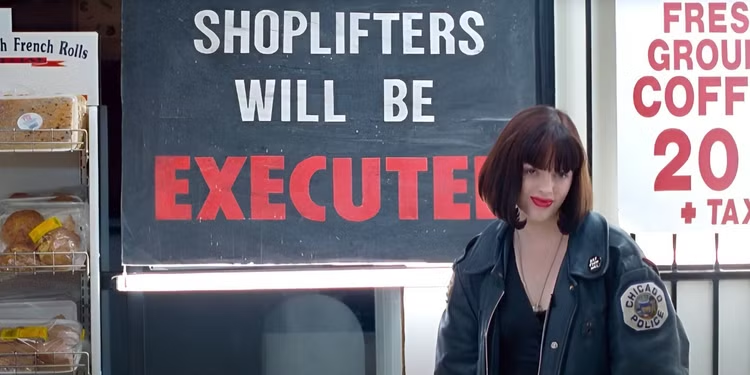
With this description of New York from “Doe Dislocated”, the narrators’ fawning becomes contextualized as a more symptomatic reaction to the flat, un-carnal nature of the city. A city that, due to its expansiveness, lacks doom, days flapping by like placeless wings, with no real cost or affect attached to relationships. Chelosky’s narrators claw against this placelessness with markings: photographing a deer bleeding on the road (“Doe Dislocated”), setting a boy’s apartment on fire (“Accidental Violence”), the aforementioned pantyless fall on the street (“Snuff”). Having consumed a lot of 90’s media recently, these city-markings remind me of grocery store gore in classics like Araki’s The Doom Generation or Stone’s (not as good) Natural Born Killers, or even Hal smoking up in sub-academic tunnels in Infinite Jest: stories in which gutty youth commune with a usually neutral environment through blood, trespass, and perversion. I particularly think of the 2025 camp-revival film Fucktoys by Annapurna Sriram, in which the main character, a meandering sex worker, goes on a magical realist adventure through the “fictitious, pre-digital American city known as Trashtown” in order to raise 1,000 dollars for a removal of a curse. Don’t get it wrong: FLE is definitively post-millennial – narrators dream of answering DMs, cam-girl roommates receive Dollskill packages, and boyfriends have burner accounts on which they manifest BPD baddies. But there’s something camp in the sudden, almost accidental cruelty of characters, and the dramatic getaways the narrators often have to employ. Call it a bed-rot camp.
Some might (and, I’m sure, have) call Chelosky’s diaristic sex stories crude or tabloidal, just as Babitz’s writing and persona have been dismissed as in the past. Yet, as work, friendship, and even romantic longing become more and more virtualized, the sex life is one of the few sites of true placeful encounters left. As well, although most of the narrators’ attempts to affirm themselves through sex with men seem to fail, one of the final stories, “Bodies”, offers an antidote as painter Esme watches a stranger recognize her own body in one of Esme’s paintings, exclaiming, “that’s literally me”: “Esme imagined that the girl didn’t exist until her paintbrush stroked the canvas, that she’d given birth to this girl – who was around her age, give or take a year – standing a few feet away in amazement.” Esme’s story seems to suggest another method of self-identification, another way of giving into the other. Maybe sometimes you can fawn for one of your own.