The night’s clamour awakens the moths, which hurriedly flutter towards the light. And so, the flock begins its ritual, twisting into a massless shape that ebbs and bends with the evening. Their mirrored moment: to touch the light’s center, however, not to leave the pack. The creatures claw and step over one another, desperately to be seen, to reach, for a moment, the bright core. They flash smiles of submission, and bend their heads piously towards each other. The brief bow is complete, the dancers may take center in the ballroom. The conductor waves his baton, and the flock takes to flight yet again, quick to draw the attention of their director. They have been seen. His gaze, the beam they search for, is swiftly filled by the mass. They must be seen. The revolting flicker of their wings fills the cobbled streets, pouring into bars and cafés as liquor pours into glasses. As the vibrations of the night die away, and the musicians pack up their instruments, dawn gently breaks overhead. And so, the moths retreat to their dens, hiding away from the light of day, and ready themselves to begin their ritual once again.
*
The paradox of man is that we are never alienated from, but always alienated within. We are powerless in the overwhelming moment. This is the original curse, the reward for our expulsion from the Edenic garden, the sweet juice still trickling from our lips. The first moment [le premier moment]: that we are not invincible due to the social collective, to belonging, but vulnerable precisely because of it. The body, the collective body, does little to shield us from the seminal truth: that the individual experiences itself only as socially mediated. At the point where this mediation becomes unavoidable, which is in every case [dans tous les cas], the ego is revealed as subject, forced to conclude itself as such. Lacan refers to this instance as the moment of conclusion [le moment de conclure]: the moment in which one does not arrive at oneself, but appears, revealed insofar as one is experienced only by and through another [an other]. The very function of I is an isolating experience: we are subjects determined by our relative positionality in an order. We exist insofar as we are counted. It is difficult to accept this exposure.
The ego [mis]represents itself as an immediate power of self-relation. In thinking itself, it seems to secure its own existence, to equate itself with an I, as a function of I. This semblance of immediacy hardens into certainty. It reaches its canonical form in the Archimedean ‘first principle’ of Western philosophy, where Descartes installs the cogito as foundational: I think, therefore I am. The reversal of the centrality of the subject is one of the primary lessons of the Lacanian tradition of psychoanalytic philosophy, though its logic is already present in Hegel. As aforementioned, the subject never appears to itself except through mediation by an Other. The I marks no inner core; it is an imaginary construction assumed. Identity never emerges as possession, but as recognition: always deferred, always dependent. What calls itself selfhood survives only insofar as it is sustained within the other of others: “before the formation of the subject, of a subject who thinks, who situates himself in it [...] the level at which there is counting, things are counted, and in this counting he who counts is already included.” In Seminar XI, Lacan utilises the curious analogy of the three brothers: “I have three brothers, Paul, Ernest, and me. But it is quite natural—first the three brothers [...] are counted, and then there is I at the level at which I am to reflect the first I, that is to say, the I who counts.” One cannot count oneself if one does not occupy positionality in the structure: to be able to count oneself as one of the three brothers, the I occupies a position in the relational structure of the brotherhood, prior to the formation of the I who counts. The order, the structures we are born into, already count us before we know ourselves.
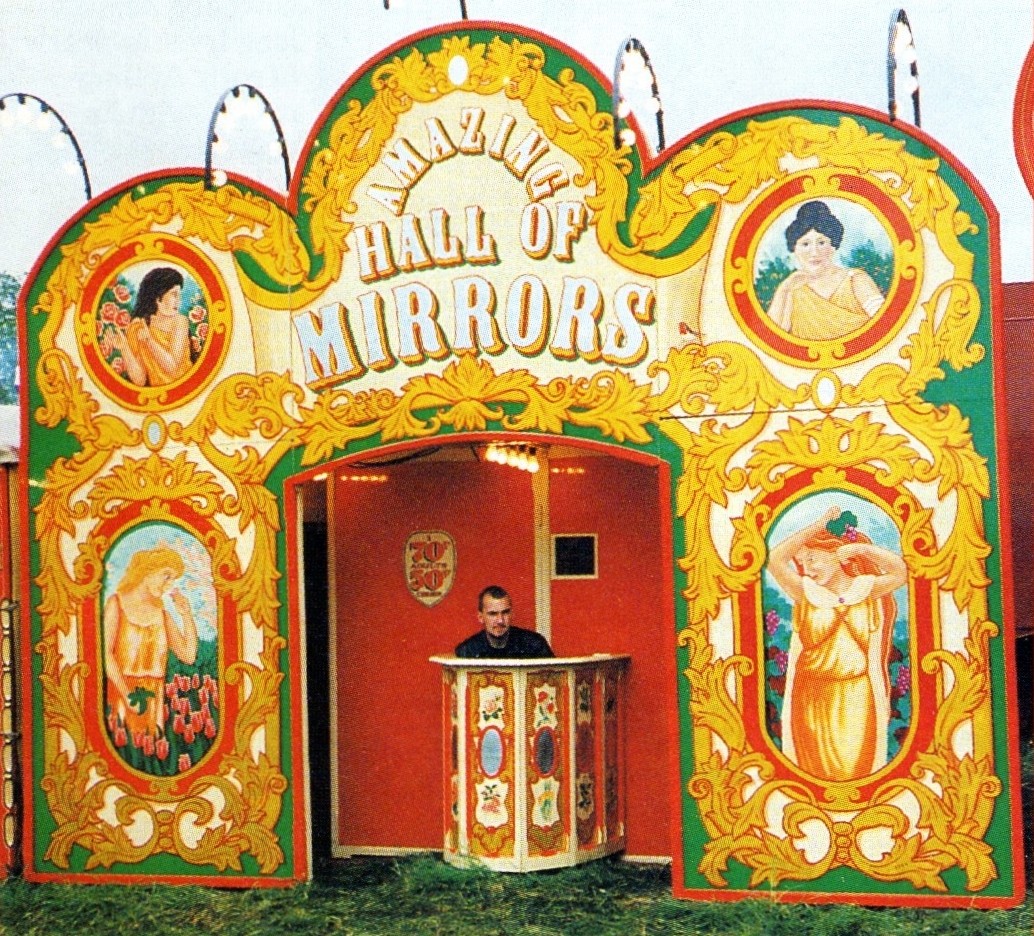
Exchanges of affection between two lovers show us this in its purest form; they take each other into their arms and proclaim openly: you count. This expression is as much an endearment as a begging imperative: please count! Count me! To be considered is not merely to be desired, but to be recognised as occupying a place in the world of the other. And so, we are sentenced to our only mode of being: to roam endlessly in the hall of mirrors. Alienation, thought as the loss of something possessed, is not so. It is the price of having appeared at all.
And thus the Lord God calls to the man, “Where are you?”
He answered, “I heard you in the garden, and I was afraid because I was naked; so I hid.” *
If alienation is not a historical accident but a structural condition of subjectivity, then any critique that treats capitalism as the origin of alienation mistakes effect for cause. This point, on the structural condition of subjectivity, was the focus of Marcuse’s Five Lectures: Freedom and Freud's Theory of Instincts, in which he recognised that there was an inherent link between the political sciences and a less obvious, more covert mechanism, namely that of psychoanalysis (or philosophy, for that matter). Marcuse justifies the relationship through a twofold dynamic: that the structure of Freudian theory “is open to and in fact encourages consideration in political terms, [...], that this theory, which appears to be purely biological, is fundamentally social and historical,” and its inverse, namely that the political sciences inherently hold psychology as an “essential part.” Marcuse recognises that the psyche “appears more and more immediately to be a piece of the social totality, [of] individuation.” The addressal of the problem of individuation (instead of subjectivity) stems from a specific epistemological position—or tradition—that would be initially established by Max Horkheimer in his 1937 essay-lecture Traditional and Critical Theory, from which the rest of the praxis of critique would emanate from, and a School that, of course, Herbert Marcuse would form part of. Horkheimer attempts to resolve the seemingly impossible position between ahistorical universalism and historicist relativism, wherein he posits that critique itself, despite being historically situated, gains its normative force immanently, from real social contradictions rather than timeless principles. Thus, subsequent work conducted by the School would naturally direct their critique into historical, rather than ontological grounding; Marcuse is not asking what a subject must be in order to exist. Instead: how is the individual formed under specific social and economic conditions? Marcuse structures his argument less in terms of subjectivity, but turns to a more historico-political term: of individuation: “synonymous with apathy and even with guilt.” Apathy is not laziness or melancholy, it is political impotence internalised. The subject experiences themselves as isolated, where power is displaced onto institutions and systemic faculties. Guilt is the former’s reversal: where structural failures are experienced as personal failures. Marcuse, however, also touches on something revealing, when he claims that individuation is synonymous with “also with the principle of negation.” Marcuse briefly glimpses the edge of a structural claim, flirting with a condensation via Hegelian negativity, but never letting it harden into an ontological thesis. When speaking of the negativity of individuation, Marcuse recognises that to be an individual is to be non-identical in the first place: that something is always wrong in being. However, instead of recognising negativity as constitutive of subjectivity qua subject-being, Marcuse whittles negativity into the site where repression and domination register themselves.
This is precisely where Lacanian theory can ‘save’ critique, and we return to our original claim, that alienation (or individuation, for that matter) is not a historical accident proper, but a structural condition of subjectivity as whole, revealing that systems, such as neoliberal capitalism, do something far more perverse: of exploiting the fundamental impasse of subjectivity and perpetuating it into its extreme forms: a parasite on the inherent lack. This inherent problem of lack-less subjectivity in one present in humanist Marxism, and apparent throughout Marcuse’s writings as well: that there exists some ‘complete’ version, a “human essence,” somehow ‘untainted’ prior to capitalism’s infiltration. Humanist Marxism presupposes a positive human experience that capitalism alienates: where an event that is entirely “inscribed in the logic of the existing order is (mis)perceived as a radical rupture.” Žižek likens this (mis)perception in the dichotomy between the old and new, in which the old somehow possesses an “untainted possibility,” to critique in the domain of sexuality itself. Žižek points to the arguments against “‘virtual’ or ‘cyber’ sex [...] as present[ing] a radical break with the past, since in it, actual sexual contact with a ‘real other’ is losing ground against masturbatory enjoyment, whose sole support is a virtual other—phone sex, pornography, up to computerised ‘virtual sex,’ [...] [where] the Lacanian answer to this is that we have to expose the myth of ‘real sex’ allegedly possible ‘before’ the arrival of virtual sex.” The central Lacanian thesis that “there is no sexual relationship” [il n'y a pas de rapport sexuel] indicates precisely that the structure of ‘real’ sexuality is “already inherently phantasmic,” wherein the ‘real’ body of the other forms an imaginary relationship with the “subject qua sexual-subject.” In this same regard, we should not treat social critique as assuming a totality of subjectivity that somehow existed prior to certain conditions [of capitalism, for example] that causes the socio-political alienation that it so critiques [e.g. capitalism does not produce alienation, rather, it parasites the structural impasse of subjectivity].
In addition, in reading Girard’s mimetic subjectivity, we see a profound overlap between his theories and the aforementioned structural failure in subjectivity itself. Despite Girard’s rejection of certain Lacanian principles, we see a shared interest in the relational structure of desire and the Other [l’Autre], and, even more interestingly, in the concept of the mob [la foule], which, of course, is the central discussion of this analysis. It is of interest to read Girard in the negative sense, that is, what is left implied or secondary to his primary tenets. Girard’s primary locus of interest is on scapegoating, wherein his readings of archaic texts point to the patterns of social contagion and mob violence he was so fascinated with. For the French theorist, all collectivity begins with envy: “all desire is a desire for being.” In this way, “we look with covetous eyes at someone we fantasise has it all, who represents our derivative aspirations, [...] [where] the enmity itself is the contagion, spreading until the whole community is in a mimetic meltdown, […], as the community converges on the culprit, a new unity emerges.” It is in this foreword, written by Cynthia Haven, that the concept of la foule becomes concrete: in the same way that a subject must define itself against an other, so must the crowd. As cells become tissues and organs, they become differentiated; what more is difference than being positioned against something else? “We are all persecutors,” proclaimed Girard at a Stanford conference. “Our competitive and covetous quest for job perks, for political clout, sexy bedfellows, or an entrée into an élite clique spreads contagiously through society and leads us to conflict and ultimately escalation.”
*
Modernity introduced a subtle but decisive transformation in the understanding of alienation. What had once been experienced as a metaphysical or theological condition became reinterpreted as a historical and economic malfunction. With the rise of industrial capitalism and its critique, alienation was increasingly understood as the product of specific social arrangements rather than the structural condition of subjectivity itself. This shift was politically necessary, for it allowed critique to identify domination as contingent rather than eternal. Yet it also introduced a new fantasy: that alienation itself could be abolished through institutional reform. Institutions no longer merely organised social life; they assumed the burden of ontological repair. The promise of belonging became inseparable from the promise of wholeness. It is this promise that contemporary inclusive spaces inherit, and this impossible demand that ensures their inevitable failure. What becomes evident is the following: that institutions, the very systems set to ‘solve’ the problem of alienation, do precisely the opposite, solidifying alienation into identity itself.
*
What is rationalised as our willingness to cast out our egoisms, to dedicate our bodies to the whole body, the governing body, is no more a misrepresentation of the “universal objectification of egoism” itself. The establishment of the society, of collective spaces, is the result of finding ourselves powerless. What presents itself as collective belonging (inclusion, pluralism, self-expression) is actually a system that aestheticises egoism and alienation. As Adorno writes, “the individual [must] experience himself only as socially mediated.” The very institutions made by us are thus “additionally fetishised,” as subjects can only know themselves as exponents of institutions, these “hav[ing] acquired the aspect of something divinely ordained.” Adorno brilliantly notes: “[y]ou feel yourself to the marrow a doctor’s wife, a member of faculty, a chairman of the committee.” However, this is not merely an illusion, this is entirely constitutive of reality: “compared to the illusion of the self-sufficient personality existing independently in the commodity society, such consciousness is truth.” We really are no more than a doctor’s wife, a member of faculty, a chairman, an aesthetic director, a member. This reality is what drives member-ship: to be a member is to be a part of the whole, without which the whole would disintegrate and cease to exist ab initio. The very socialisation of human beings perpetuates our asociality, “allowing not even the social misfit to pride himself on being human.” At heart, we are deeply alienated. Our expulsion from the Garden has left us like the ataphoi [the unburied ones]: those restless spirits denied passage into the Underworld, left to haunt the living until properly buried.
The ‘solution’ of the body seems to further multiply the very divisions it seeks to ‘solve.’ The very nature of the inclusive space is that it functions precisely on principles of non-inclusivity. This principle is most evident in the new-age reconstitution of classic structures. The authoritative, paradigmatic, orthodox, and mainstream models of the institution ceaselessly operate, and continue to operate, on the basis of exclusion. The bank, the school, the honourable society filters its candidates and selects within pre-determined categories. Even diversity has to be imposed from the outside, their explicit function is always implicitly determined: the most irregular of constituents serve no more than bookmarks of pseudo-conformity, further polarising and proliferating the frustrations of its puritan members, preserving and multiplying the identity against an Other, all the while these heterodox members serve no more than symbolic diffusers of obedience to a society that partakes in the game. Much like Lacan’s Prisoner’s Sophism, in which three prisoners must try to logically conclude the conditions of their position [black hat/white hat], the ‘rules of the game’ are implicitly determined in the ‘game’ of the institution. It is said that once, a visitor came to the home of the Nobel Prize–winning physicist Niels Bohr and, having noticed a horseshoe hung above the entrance, asked incredulously if the professor believed horseshoes brought good luck. “No,” Bohr replied, “but I am told that they bring luck even to those who do not believe in them.” We understand the rules of the game very well, and, to maintain the structure of a society we would otherwise be terrified to change, we partake in the ‘game’ itself, even though we do not believe in it. Far more perverse is the moral superiority complex that belongs to the organisations of the counter-current: the ‘new Marxist’ club, the poetry society, the ‘Queer Space Against Capitalism,’ the multi-faith research centres, and so on, to all those who ‘oppose the doctrine.’ It is in these very spaces, in which the abnormal is ‘celebrated,’ that the Girardian mechanics of the social body come to light. In reality, the voices continue to belong to the young, the beautiful, those who possess a sexual grasp over the others: the desirable. Heteronormativity is merely transformed: the goalposts have simply been shifted.
And, on the other end, the boisterous, crowd-provoking deviants are celebrated wildly, the brave few, whom the societies push forth as evidence of their generous heterodoxy. Their courageous and spirited character attract the eyes and ears of the many: they deprecate themselves, they adopt an attitude of ultimate laissez-faire, everything is taken to its extreme excess, and the society exploits their self-erasure to its limit, dressing it up as radical self-expression. Behind this is the tacit agreement: to be seen, you must embody the characteristic of the atypical, of the abnormal. The so-called ‘open spaces’ remain open to those who are willing to perform their own excesses, humiliation, and instability, in a way that becomes consumable. Selection itself has become aestheticised. As Adorno writes: “the socialization of human beings today perpetuates their asociality, while not allowing even the social misfit to pride himself on being human.” This phenomenon is all too evident today, in these self-described pluralistic spaces, which offer no more pluralism than the very authoritarian institutions they so desired to deviate and rebel against. Everything is a game of social hierarchy: the brute, the silent one, the good, the ugly: they are all welcome, however not all are welcomed within. There is a clear distinction between authentic inclusion and symbolic hospitality: whilst all may enter the room, not all are allowed to inhabit it. Those at home, truly at home, find themselves no less constructed than the actor. Perhaps some even rehearsed their lines at home. Maybe some spent the last of their earnings on a jacket that was ‘in style’ at the last gathering, only to find that the item was ‘so last time’ at the next. And so, those who protest capitalism with cries and tales fail to see their own hypocrisy: to consume all the more to ensure their appearance reflects their genuine individuality, without recognising their active participation in the perpetuation of symbolic performance. The apparatuses of expression are valid insofar as they remain in the space of the heterodox–acceptable, that is: be yourself, but as how we see fit. Be radical, but not awkward; angry, but photogenic.
The problem seems to be not that we have failed to build inclusive spaces. Rather, it is that we continuously demand from them what no space can give: the abolition of alienation itself. The phantasy of full inclusion is merely the latest form of denial: a refusal to accept that subjectivity itself is constituted by lack, not cured by belonging. To appear is to be already exposed; to be counted is to already be divided. What remains is not the hope of a reconciliation of attaining a totality, a certain whole-ness, but the courage to inhabit division without converting it into spectacle. Alienation must not be overcome. It is what must cease to masquerade as identity.
1. Jacques Lacan, Écrits, trans. Bruce Fink (New York: W. W. Norton, 2006), 203–215.
2. Jacques Lacan, The Seminar of Jacques Lacan, Book XI: The Four Fundamental Concepts of Psychoanalysis, trans. Alan Sheridan (New York: W. W. Norton, 1978), 20–24, 67–78.
3. René Descartes, Meditations on First Philosophy, trans. Donald A. Cress (Indianapolis: Hackett Publishing, 1998), 17.
4. G. W. F. Hegel, Phenomenology of Spirit, trans. A. V. Miller (Oxford: Oxford University Press, 1977), 111–119.
5. Jacques Lacan, The Seminar of Jacques Lacan, Book XI: The Four Fundamental Concepts of Psychoanalysis, 139–140.
6. Sigmund Freud, “Group Psychology and the Analysis of the Ego,” in The Standard Edition of the Complete Psychological Works of Sigmund Freud, Vol. 18, trans. James Strachey (London: Hogarth Press, 1955), 67–143.
7. Herbert Marcuse, Five Lectures: Psychoanalysis, Politics, and Utopia, trans. Jeremy J. Shapiro and Shierry M. Weber (Boston: Beacon Press, 1970), 9–56.
8. Max Horkheimer, “Traditional and Critical Theory,” in Critical Theory: Selected Essays, trans. Matthew J. O’Connell et al. (New York: Continuum, 1972), 188–243.
9. Herbert Marcuse, Five Lectures: Psychoanalysis, Politics, and Utopia, 44–46.
10. Karl Marx, “Estranged Labour,” in Economic and Philosophic Manuscripts of 1844, trans. Martin Milligan (Moscow: Progress Publishers, 1959), 72–81.
11. Slavoj Žižek, The Sublime Object of Ideology (London: Verso, 1989), 45–53.
12. Slavoj Žižek, Looking Awry: An Introduction to Jacques Lacan through Popular Culture (Cambridge, MA: MIT Press, 1991), 32–45.
13. Jacques Lacan, The Seminar of Jacques Lacan, Book XX: Encore, trans. Bruce Fink (New York: W. W. Norton, 1998), 35.
14. René Girard, Violence and the Sacred, trans. Patrick Gregory (Baltimore: Johns Hopkins University Press, 1977), 1–52.
15. René Girard, Things Hidden Since the Foundation of the World, trans. Stephen Bann and Michael Metteer (Stanford: Stanford University Press, 1987), 283–305.
16. Theodor W. Adorno, Minima Moralia: Reflections from Damaged Life, trans. E. F. N. Jephcott (London: Verso, 2005), 15–18, 154–158.
17. Theodor W. Adorno, Minima Moralia: Reflections from Damaged Life, 103–104.
18. Theodor W. Adorno and Max Horkheimer, Dialectic of Enlightenment, trans. Edmund Jephcott (Stanford: Stanford University Press, 2002), 94–136.
19. Jacques Lacan, “Logical Time and the Assertion of Anticipated Certainty,” in Écrits, trans. Bruce Fink (New York: W. W. Norton, 2006), 161–175.
20. Slavoj Žižek, The Ticklish Subject: The Absent Centre of Political Ontology (London: Verso, 1999), 323–335.
21. Genesis 3:9–10, New Revised Standard Version Bible (New York: National Council of Churches, 1989).
22. Charles Taylor, Sources of the Self: The Making of the Modern Identity (Cambridge, MA: Harvard University Press, 1989), 159–176.