

Briefly Gorgeous opened at Soho Revue on the first Wednesday evening of March this year, featuring works by Juno Calypso, Daisy Collingridge, Aarony Bailey, Morgane Ely, Ada Bond, and Olivia Bryant. The show was inspired by Naomi Wolf's The Beauty Myth and showcased a myriad of photographic and sculptural works swimming in pink hues, dedicated to the concept of female beautification. Soho Revue described the show as portraying beauty as an “act of defiance” (Soho Revue, 2026), attempting to escape its roots in male dominance. Each artist experimented with the “realisation that we are dancing beautifully, just in a box built by limitless, never-ending rules” (Soho Revue, 2026). Whether each artist supported or opposed female beautification, they all advocated for a loosening of conventional beauty standards. With a trace of caricature, artists like Juno Calypso and Morgane Ely explore this by staging exaggerated scenes of femininity in a way that feels less like parody than performance. The defiance lies in the refusal to offer an authentic self for the viewer to consume. It’s cool, controlled and knowingly excessive, yet resistant to clear interpretation.


The qualities of this show directed the viewer to a new and evolving type of female gaze. Neither a common enemy nor friend, the ideas of feminine beauty have become hyper-realised, forming a new type of hyper-femininity that is hyper-stylised and poetically artificial. Feminine beauty has entered a new era of representation in contemporary art. This style of art is different but slightly familiar to realised forms of parodic art, following a similar formula of vibrant, satirical and sometimes grotesque aesthetics and exaggerated content matter. But how is it different? Why is it different? What is the purpose of this shift and why is it happening?
What we see from these artists is a post-internet sensibility. Arguably a psychological residue of being born into an online world – hyper-femininity in this context occupies a more liminal space. Where it avoids self-celebration and self-criticism, this trend of work sees a deadpan simulation rather than camp, parody or pastiche. Looks and aesthetics are intense and excessive, but emotionally they are distant and ambiguous, refusing a stable identity. Artists of this genre intentionally disturb and confuse the viewer, suspending them in unreality.
Performing something too perfectly can become the best way to expose it. As Slavoj Žižek writes through theories of Over-Identification his Subversive Affirmation, critique can collapse into the performance itself (Žižek, 2006, p. 63). This new female gaze inhabits its performance so fully that critique collapses into it. Resembling early works of Cindy Sherman, this form of hyper-femininity seeks to resemble an uncanny figure to display whether we can still recognise ourselves in this idea of femininity and whether there is a distinction anymore.
![Sherman, C. (2003). Untitled (Self-Portrait with Sun Tan). [Photograph]](https://cdn.prod.website-files.com/68949d3b4cc45e931e20f6cf/69fdcd64b263c94e9f785d81_155_001.jpeg)
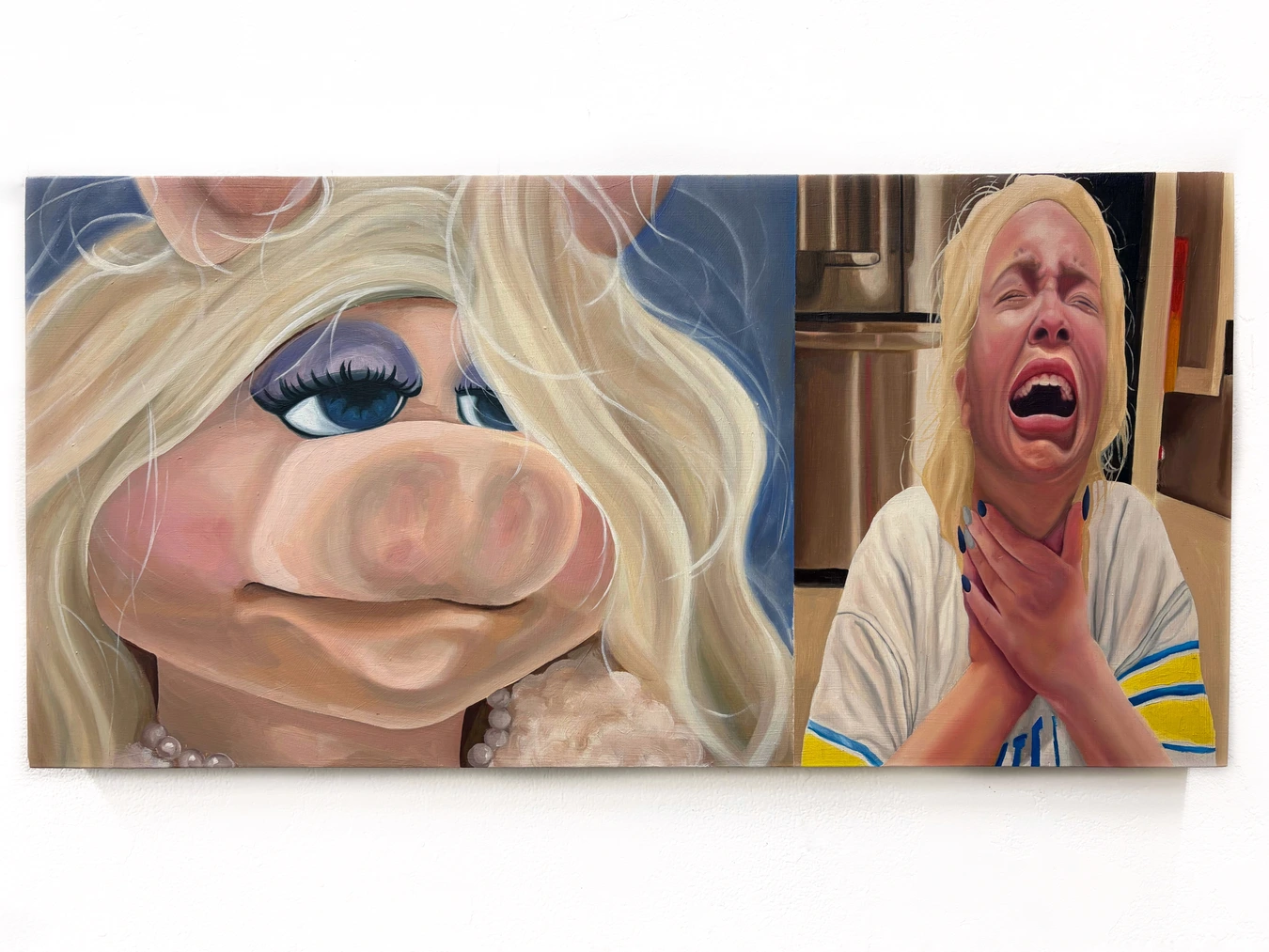
Canadian artist Julia De Ruiter is a prime example of this sensibility. Exploring the avid effects of unsupervised internet activity on a young girl, De Ruiter paints stylised oil paintings that depict internet culture and its adverse effects on women. Her work acts not as a mockery but as a performance gone wrong. In Blonde is Better, by juxtaposing Miss Piggy with Trisha Paytas crying, De Ruiter recognises styles of femininity but distorts them into something weird, showcasing how femininity breaks down under its own construction. What this kind of representation of post-internet artistry demonstrates is that the internet has acted as a kind of desensitiser to the abject (Kristeva, 1980) and has allowed us to act as detectors of the awkward, slightly off performance of stylised femininity. The image of femininity that Julia De Ruiter presents in her work is a shattered surface. There is nothing deeper to reveal that was obvious on the surface. It leaves the audience with the ultimate question: is there authenticity to this pantomime? Or is this performance all there is?
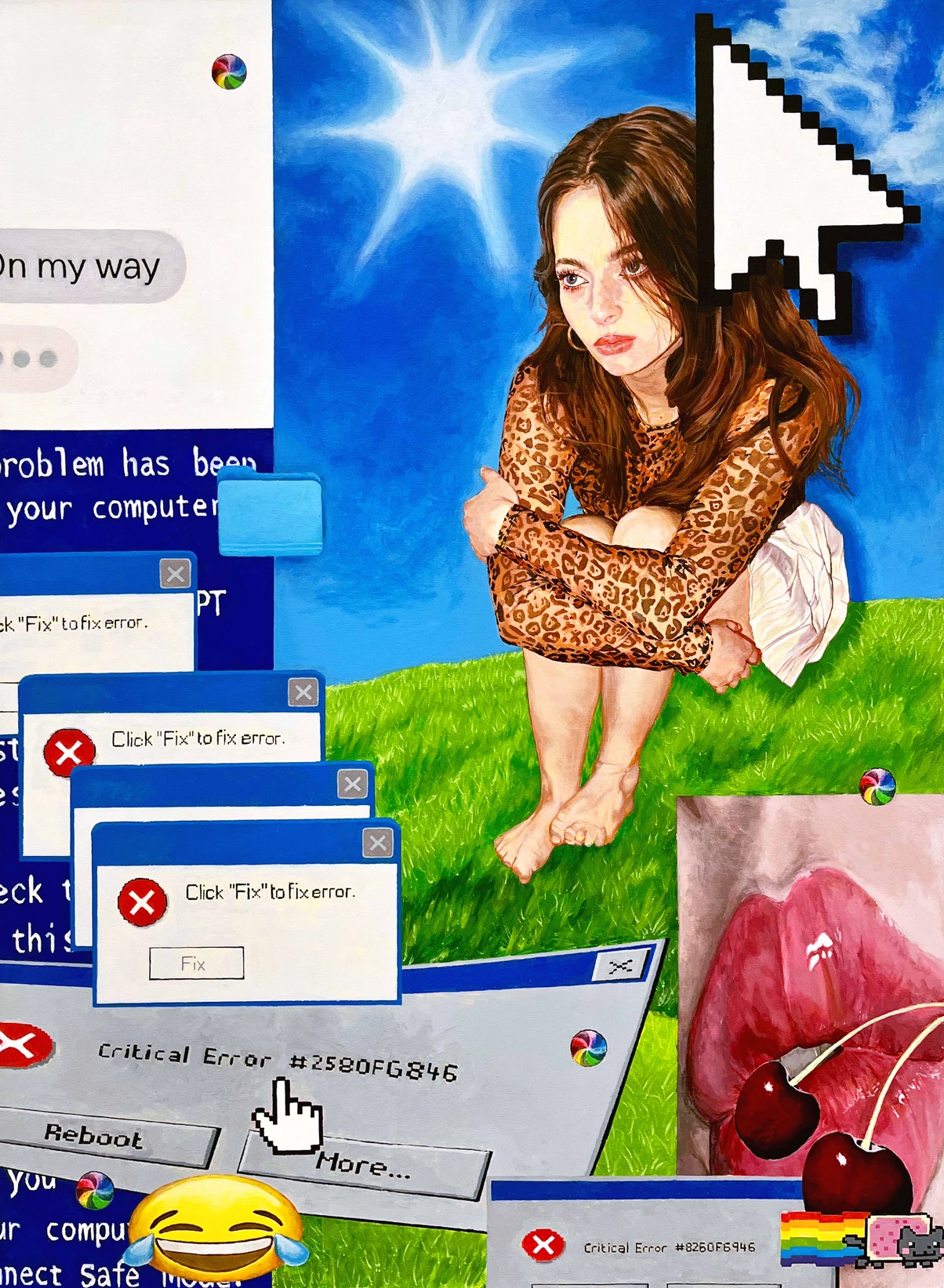
This idea also becomes apparent when looking at the work of Canadian artist Sophie Jackson, whose hyper-realism portrayal of digital femininity proves the performance is empty. As an artist, Sophie Jackson investigates the interplay between personal identity and the digital age, specifically looking at how pop culture iconography plays into our narratives. Conceptually ambiguous, Jackson assembles motifs and scenes from our digital landscape to highlight the performative aspect to it. The juxtaposition of digital imagery against traditional oils start to feel unbalanced. The paintings expose to us that the circulating visual language of femininity isn’t something natural, but something deeply constructed. The dedicated and incessant detail of Jackson’s work transpires as overidentification, shining a light so forcefully on digital perfection that it exposes its flaws.
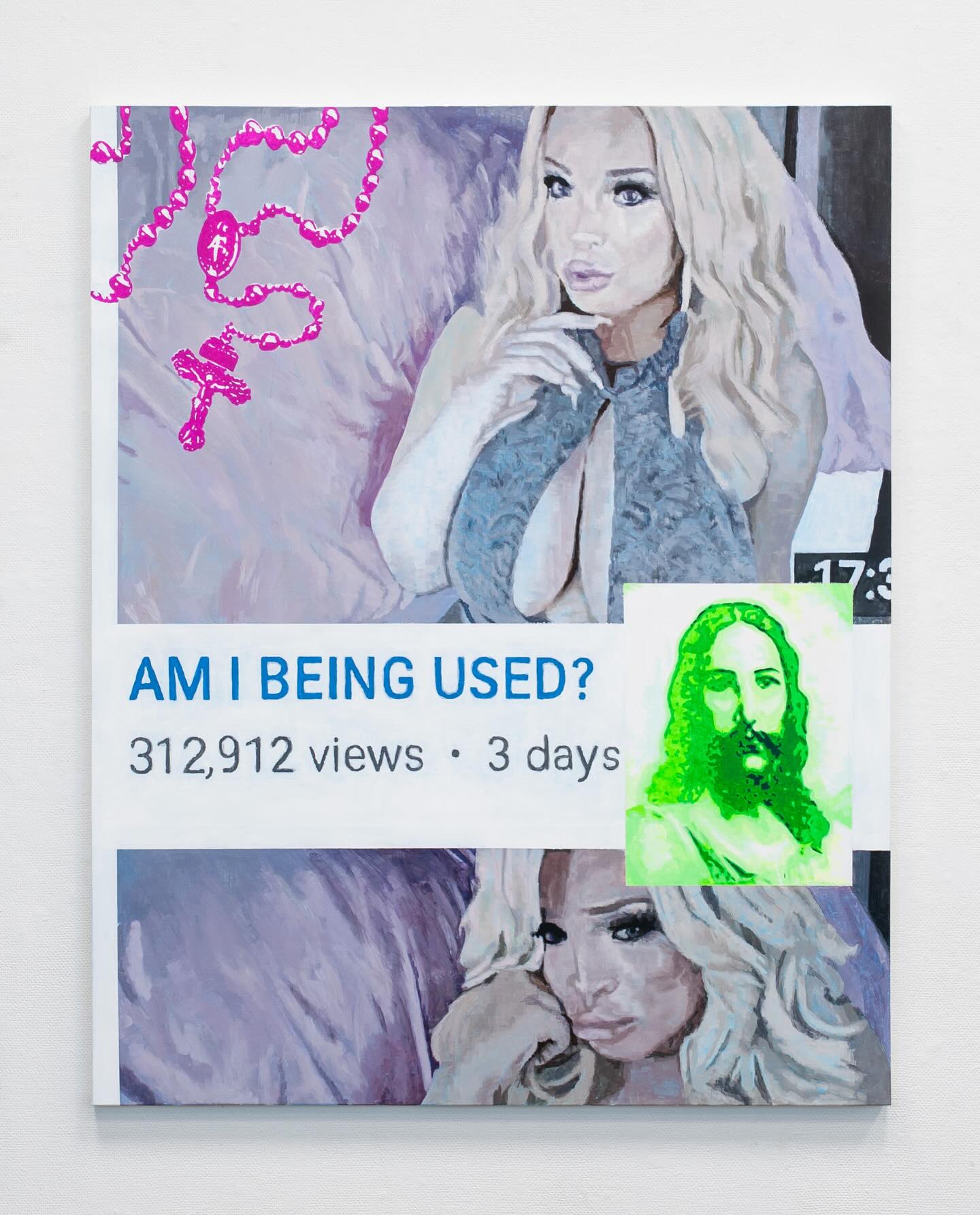
While De Ruiter and Jackson’s work on hyper-femininity is similar, they are not the only voices on the subject. Lily Bunney is a London-based artist exploring the visuals of digital consumption. What Bunney’s work does differently from Jackson and De Ruiter is that it works to inhabit femininity gently through vulnerability and offers a new argument on the distinction between ‘real’ and ‘fake’ femininity. Through her stylised pixelated scenes of female friendship and solidarity, emulating posts and photos from social media, Bunney is questioning how one builds identity in a social world and how one’s social identity adheres to digital standards of femininity. Bunney’s pixelated scenes of womanhood, while not subverting stereotypical femininity, act to redefine their ‘empty’ moments or motifs into something fulfilling and authentic. Rather than staging femininity as critique or exaggeration, Bunney situates it within lived, ordinary experience, where the real is already shaped by digital perception. Bunney is ultimately questioning whether the displays of vulnerability and femininity that we see online or on our screens are real and, therefore, questioning what makes femininity real or fake.

What is obvious from the work of these three emerging artists is that the medium is changing. Artists are tired of battling the constant tension between real or fake femininity, raw or posed. As emerging voices on the topic, their mutated sense of post-internet femininity offers these artists a lessened patience for controlling beautification, and they instead troll it for its lack of substance. So, they created a new monster altogether, a representation of the complexities and contradictions inherent in femininity and artistic expression. What is coming from this medium is a level of grounding. As these artists expose the imperfections in the perfect performance, they may have sought to destroy the intention of performing altogether, aiming to challenge traditional notions of artistry and authenticity in a world increasingly dominated by curated images and expectations. Like a snap out of the trance, hyper-femininity may instead be understood as the antidote to the post-internet mirage of beautification, where the sensibility is one of awareness, allowing individuals to critically engage with and question societal standards of beauty and femininity.
March (2026). Briefly Gorgeous. [online] Soho Revue. Available at: https://www.sohorevue.com/exhibitions-1/brieflygorgeous-march26.
Kristeva, J. (1982) Powers of Horror: An Essay on Abjection
Žižek, S. (2006) Why are Laibach and Neue Slowenische Kunst not Fascists?, in Žižek, S.The universal exception: selected writings, volume two. London: Continuum, pp.63-66.