
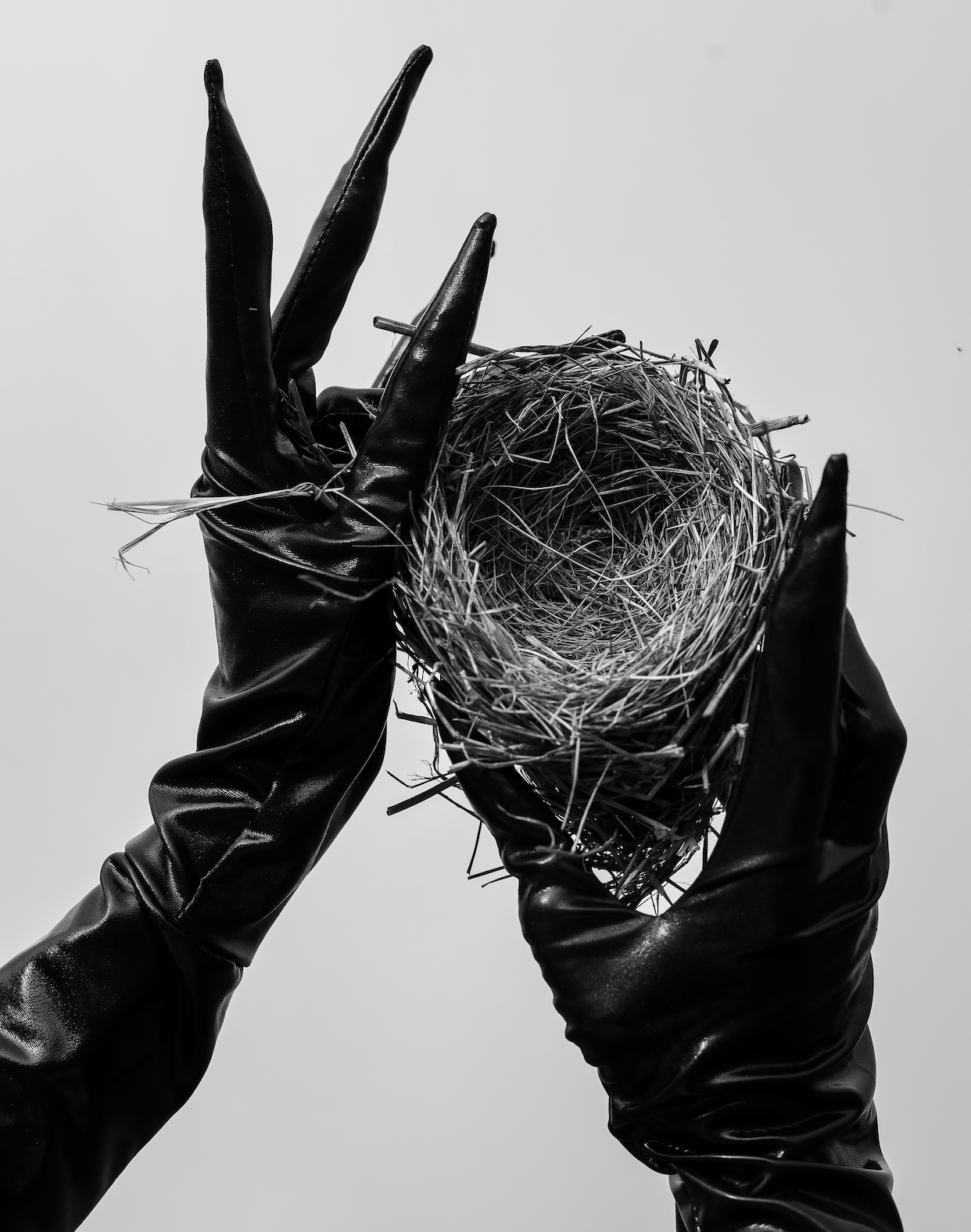
“Sleep on your back with your face up. When the jaguar comes look it in the eye, so it knows you are not meat” (Kohn, E., 2013).
#
Robin looks at the tiny, lifeless songbird laid out on the counter. He had been fattened morbidly, and his eyes were either sunken or removed. She can’t tell. His feathers cling against his pale skin, which has taken on the color of the brandy. “What did you say it was again?”
Her husband tightens his apron before messing with the old, wood-burning stove. “They are called Ortolans, and we’re going to roast and eat them.” He licks butter and basal oil from his fingers, then pulls her in with that same hand. “Me and my wife.”
The room quickly gets hot from the oven. Robin seizes her phone from the butcher’s block to look up how Ortolans are prepared. She takes it to the bathroom and locks the door. The towel falls from the hook on the back, and when she unbends to return it, she notices in the mirror that her skin is red all over, flushed from the oven.
“Jesus. The bones and everything?” She slams her phone face down by the sink. She is sick, imagining herself spiraling around a cage in the dark.
Robin showers the sweat from her skin in cool water before escaping to the bedroom before dinner. She can’t un-picture that little bird. She parts heavy sections of clothing from the closet rack, trying to find something light to put on. The heat crawls up the hallway, unfurling into the rooms like roots stretching into the earth. Finally, Robin finds the controversial lingerie dress, a sheer black camisole with a deep V-neckline attached to a short slip skirt. She moves down the dark hall, heat intensifying with every step. The narrow opening shows only her husband’s vast, glowing vintage oven, giving the illusion that Robin is walking directly into it.
Her husband does not look when she enters the room. There is a wreath of candles in the center of the table and two black veils hanging over Robin and her husband’s chairs.
“What are these for?” she asks.
Keeping his eyes planted thoroughly in his salad preparation, Robin’s husband responds, “They are meant to shield us from God’s judgment.”
Robin makes a face before grabbing two plates from the cabinet for their salads. She notices her husband’s eyes follow her back hemline as she turns and then snap back to his salad station, where she sets down the plates. The last breath of life this dress witnessed was an explosive argument, worn beneath an untied kimono to the beach one afternoon while on vacation with her husband’s family. She and her husband were only running out from their beachfront hotel for a second, hoping to catch the sunset before dinner. He didn’t seem to have a problem, Robin thought, until he realized his family had come to the beach, too. Robin thinks to herself that it should be fine for having dinner alone, especially when the kitchen is this hot.
“The Ortolans should be done soon,” her husband says, pulling out her chair.
Robin places the veil around her shoulders for now. She is struggling to hide her discretion between bites of salad. She has playfully mentioned the bones freaking her out and thinks she may faint when her husband opens the oven door to check his dish.
Husband turns off the oven and retrieves the two pieces of tableware from their place settings. Time seems to move too fast for dizzy Robin. She pours the Merlot into their goblets as her husband plates in her peripheral vision.
Sensing the need for intervention, Husband reminds her they just ate bone marrow last week, and that she didn’t think twice about it.
“But I did think. I thought more than twice,” Robin whispers to herself. She eats plenty of things. She eats foie gras and whole fried fish with raisin eyes staring back at her, but she does think. There are things she won’t eat. Blood sausage, for instance, is a step too far. Her husband knows this about her. He brings forth the plates.
Robin’s husband sets the Ortolans down in front of them. The bird lies immodestly on a bed of lettuce Robin suspects she is not supposed to eat. The spaces for his eyes bulge. All his fat and skin fused and have become golden as if he’s been laying at the beach all day. The dish is pretty, Robin admits.
“You’ve made him gold,” she tells her husband while gently prodding the bird with her finger. “That sounds like a fairytale,” he replies. “The golden songbird.” It is very nearly believable.
It is time to eat the bird whole. Robin feels she needs ice water for the heat, not heavy merlot. Her husband gestures towards the veil and watches her put it on. She hears him put his on hastily after. Robin doesn’t like the idea of being hidden from God, and when she really thinks about it, she already sort of feels that way. She hears her husband’s quick, hot breaths and wonders if God is deaf. She does not eat the bird but places it beneath the table like smoldering coal.
They remove their veils, having had entirely different experiences, her husband satiated, and Robin prepared to lie. She did not allow herself to even smell the bird but could still describe the taste with accuracy. Though Robin didn’t enjoy it, her husband was not difficult to fool. “One of your bests,” she tells him.
Before dessert, her husband runs to the bathroom, and Robin reaches beneath the table to place the Ortolan in the rafters instead. They are low enough to reach when she stands on the chair. Though the house is new and “sanitized,” as Robin often calls it, the kitchen is part of an older house that once stood on the property from an early settlement, which accounts for the large hearth and low ceilings. Her husband was fine with a new bedroom, a pristine, updated bath, but was adamant on preserving the heart of the property. She figures her husband will take out the trash and see the Ortolan, so she plans to dispose of it tonight.
#
“I can still smell the Ortolans so strongly,” says Robin’s husband, entering the bedroom from the hall. In the middle of his small talk, he sneaks a look at Robin, sprawled out on the bed—hot, then returns to his comments about the meal. Robin notices and wonders if her husband talked about her to the bird, the meal, as he was cooking. She remembers he only referred to the Ortolans as delicious once they were already consumed, or at least once he thought they were.
She twists into a kind of pose like you might see on a magazine cover, stretching her arms, which fall slightly crossed above her, with relaxed hands. She tries to come off as natural as possible in her endeavor. Her husband continues to go from one part of the room to the other, preparing linens and things before bed. He holds his eyes closely to his tasks and looks up only when Robin wipes reflex tears from her eyes.
“I think the oven is getting to me,” she says, no longer feeling well enough to pose. The instant her body relaxes and her thighs balloon against the bed, his attention comes traipsing in.
He crawls toward her, laying his head on her abdomen. She does not tell him his head is too heavy to lie on the soft part of her stomach unprotected by her ribs. She looks at the wheat-colored swaths of thick hair as he props himself up over her.
“Do you remember when I gave your body a nickname in college?”
She does. Natalia. She hated it. She still hates it. It makes her feel like her body’s sister.
“My body already has a name. My body’s name is Robin. I am my body,” she laughs at the ridiculousness of her having to say it. She thinks there is no way he could not know this.
“Come on.” He rolls his eyes and rolls onto his back. “It made me feel like I had a mistress.”
Eventually, they have sex. It is not the kind of sex Robin imagines when her mind goes there, nor does she believe it is the kind of sex her husband imagines. He moves as if his mother is watching, as if Robin’s body is a birthday cake that, for now, he is only allowed to place candles on.
It is easy for Robin not to fall asleep, though her husband makes the transition before his head hits the pillow. She is entertained by the way his whole body fights the process, how it jerks during each phase of progression. She laughs at the idea that total relaxation is a series of battles fought and lost by every muscle against his body into twitching forfeiture, until he lies finally inanimate.
As Robin tiptoes through the house, she cannot tell if her eyes are still bothering her or if it is just the dark. She stumbles more than once on the thick, old wood of the kitchen floor. She scoots her chair slowly from its place beneath the table and slips her weight carefully from one leg to another until she is balanced. The kitchen is the only room that is still hot, even hotter as she rises, as if she is playing a game of hot or cold with the songbird.
Robin lets her fingers hover from one side of the beam to the other, accumulating little pricks and splinters, until the cold, greasy bird hits the side of her hand. She nearly screams but siphons it into a sharp stream of silent air until her diaphragm begins to cramp. She is struck suddenly by the bird falling, smacking her shoulder, and becoming pieces on its way down. Robin snaps around to check the hallways for her husband. She fears she may have woken him.
She crawls down and returns the chair, then kneels to gather the pieces once the coast is clear: a leg, a wing, a body, but no head. She does not see the poor thing’s face anywhere in the kitchen. She checks beneath the fridge, and under the sink, the dark crevices of the hearth, the foot of the oven, but she does not see its swollen eyes anywhere. She does not want to bury it without a face. She tells herself it is the most important part as she examines the pieces. Maybe its head was smashed inward on its way down. Either way, she decides to dispose of it in a little napkin in one of the cans outside.
On the way back to bed, Robin notices her fingers still smell after washing them twice. She buries them under the covers until she can shower in the morning. Her husband turns over, blinking as if he will wake. He lets out a laughing sigh. “You still smell like the Ortolan.”
Robin’s eyes become wide. “I’m sorry, Hunter. Did I wake you?”
Husband rolls to the edge, onto his feet. “No, no. I just have to use the bathroom. Get some sleep, it’s late.”
Robin is already ahead of him, exhausted by the night. So exhausted, she feels it down to her bones and begins drifting off. Robin dreams she is not in a body, or that her body is invisible. She cannot tell which. The dream starts with Robin playing hopscotch over a scattering of auburn clouds. She only begins to sink if she stays too long after landing. It is only when she realizes this rule that the dream begins to change, and she is called to wake. In those quick moments before Robin’s dream releases her, the clouds become dense and unsteady like quicksand. It begins to rain. Rain begets thunder and lightning. Robin, almost all the way sunk, is struck everywhere below the clouds, struck everywhere but her face which remains stuck above. Her entire body burns. She calls out, knowing she is not the right shape to fit into heaven. God can only see her face, and those looking up to God can only see her body.
Robin’s eyelids are swollen and heavy to open. At first, everything before her resembles a Rorschach test. It takes moments for the scene in front of her to materialize. She notices the dark cloth pulled over her breasts is not their blanket, then sees Hunter kneeling on the floor beside her, his head obscured by the veil, his shoulders illuminated by shy, morning sunlight wading through the blinds. He leans over her midsection, face down. The veil, which stretches to Robin’s feet, recedes from her chest like the tide as she breathes. Her husband is very still, and Robin is very still. He is so still that Robin cannot see him breathe. If she didn’t already know the veil’s purpose, she would swear he is praying.
Hunter begins taking very slow, deep breaths. He rises, taking the veil with him, as he gently replaces the blanket. Robin does not recognize the anger rising in her. She does not like the idea of being hidden from God or being looked at with eyes that are.
Her husband pulls the veil from his face, and, at first, his eyes lay flat upon her, like he’s gone from looking through a window to focusing on the grime all over the glass. Flat. It is only when he meets her eyes that he stumbles back.
“GOD,” as if it is her name, “DON’T LOOK AT ME.”
The blanket is crumpled in Robin’s fist. The room smells like death, like an oven. She knows it is her body that smells; little vapors twirling from her skin.
Her husband’s face is like a child caught. It turns smug unnaturally fast. “Don’t look at me like that. It was just a joke.”
Robin already knows her husband never has patience for her when she’s upset. He will continue upsetting her. He must think it best she moves on from her upset as quickly as he siphons the guilt from his shoulders. The fleshy part of her eyes creates a soft pink vignette in her vision. Looking at her husband gives Robin the illusion that he is coming down the birth canal.
“What did I even do?” he asks. “Why are you angry this time?”
Robin whips the veil from his hands. Robin thinks her husband has convinced himself he is actually confused. She is sweating buckets, sweating merlot. She throws on the veil, not wanting to be looked at any longer, only now she cannot see at all. Robin moves through the hall in a frantic zigzag, bumping into shelves and smacking against the wall. She manages to pull the veil from her eyes for a few seconds and sees herself coming down the hall from the rafters. Her husband calls from the bedroom that she shouldn’t have looked, that she doesn’t know how to share as Robin reaches for her eyes beneath the black fabric only to feel feathers pressing against her face. Her world becomes dark; her husband complains from a distant place that Robin never accepts his apologies. Robin screams and it is a song.
Kohn, E. (2013) How Forests Think: Toward an Anthropology beyond the Human. Oakland: University of California Press.


.png)