

%20(1).jpeg)
When I first came across Sean Baker’s film The Florida Project (Baker, 2017) in 2017 I was deeply drawn to the stunning visual language and the depth of his social realist framework in exploring the experience of poverty and childhood in the fringes of American society. The 6-year old protagonist
Moonee (Brooklynn Prince) lives in a vibrant, colourful motel outside of Disneyland with her financially struggling single mother Halley (Bria Vinaite). There was something thoughtful and touching about the coming together of every component of the film that genuinely struck me at the time, so when I came across the criticism of Sean Baker's style as exploitative ‘poverty porn’ I was quick to come to his defense. The argument addresses concerns that Baker adopts systemic injustice and poverty as a stylized aesthetic, packaged for middle-class entertainment without any substantial institutional critique. Seeing the thematic approach to marginalized existence as both poignant and purposeful, I dismissed these claims of glamourising hardship for spectacle as a lack of ability to engage with the film's phenomenological subtext. The Florida Project indeed rejects hollow victimhood and empty archetypes, with the characters and their environment both purposeful and authentic. However, the same cannot be confidently said for his most recent film Anora (Baker, 2024), which swept the Oscars in 2025 winning 5 academy awards. Baker similarly engaged with wealth inequality and marginalisation, but the surface level commentary made it clear that Anora was in fact guilty of the accusations of voyeurism and exploitation.
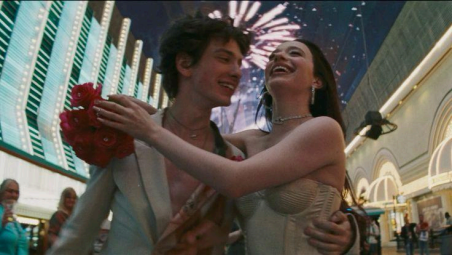
Whilst Baker was already known for shooting Tangerine (Baker, 2015) entirely on an iphone, The Florida Project was perhaps his first break into the mainstream and the stepping stone for his recent mainstream success. Anora follows the whirlwind romance between the titular character Ani (Mikey Madison), a 23 year old stripper in Brooklyn and Vanya (Mark Eydelshteyn), the young son of a Russian oligarch. Whilst still holding onto the emblematic visual style of The Florida Project, Anora was shot on 35mm Film and is visually striking, demonstrating the auteurship of Baker in his distinctive visual style and thematic concerns, with Ani working as a stripper and her working class lifestyle in stark contrast to the glamorous world she enters into upon her marriage to Vanya. Ani is introduced as a confident young woman who stands up for herself, demonstrated when she tells her boss about her issues with the strip club’s DJ rude behaviour. We see her being dazzled by Vanya’s world of wealth and excess, and the subversion of the Cinderella story is set up through exposition, sex scenes and montages of their relationship. Around the mid point, after Vanya has abandoned her, what follows is the emotional and physical torture of Ani, through forced submission and humiliation at the hands of the russian mobsters and wealthy elite who use her to track down Vanya. There is the obvious critical analysis that Anora is a comment on transactional relationships and the powerlessness of working class women in stigmatised careers. But this concept of the wealthy having control over our lives and personhood is simply superficial if that is the extent of the discussion. If enough time had been spent in exploring Ani’s internal characterisation then the external exploits of the second
half of the film would have read more significantly. Instead, Ani was simply traumatised, tortured emotionally and physically and ultimately overpowered with little sense of depth or purpose.

Laura Mulvey's critical concept of the male gaze in cinema is felt strongly in Anora, particularly at the film's conclusion when, after the whirlwind of the plot has ended, Ani has sex with Igor (Yura Borisov), one of the Russian mobsters. It reads perhaps as an attempt to demonstrate how broken Ani truly is after the events of the film, especially having to return to her life after being discarded by Vanya and his wealthy family. Worn down by the sexualisation she is constantly experiencing she thanks Igor for his kindness in the only way she knows how to, which is both tragic and psychologically resonant. However, the lack of internal exploration of her character causes this ending to come across as one final moment of exploitation the film is complicit with, again falling short of intended spectator perception. Ani’s sexualisation is hard to view as art when she is consistently refused agency by the narrative and instead treated as an object “simultaneously looked at and displayed, with [her] appearance coded for strong visual and erotic impact so that [she] can be said to connote to-be-looked-at-ness.” (Mulvey, 1975). Mulvey discusses the way films construct women to be primarily ‘looked at’, styled, framed, and lit specifically to maximize their erotic impact, existing to be gazed at rather than to actively advance the plot. Ani is at no point a truly active participant in the plot. Her decisions to pursue a relationship with Vanya are driven by her need for financial mobility, which demonstrates how financial stability is more valuable than true love in the current economically unstable climate. However, this sense of significance to her lack of agency fizzles out as the plot progresses without her. Her repetitive, surface level dialogue screaming and crying in distress
or desire to remain married to Vanya. Despite being the protagonist, the spectator does not truly know her desires or motivations beyond the wealth she needs to survive. It's frustrating to watch her be discarded and mistreated, which of course is to reflect the ways in which the rich can destroy the lives of the poor without any care for their personhood — but on a deeper, subconscious level, the frustration also stems from the film forms mistreatment of Ani for surface level social critique. When she breaks down and cries in the final moments of the film whilst having sex with Igor, the relentlessly pronounced sexualisation of her character throughout the film isn’t completely present. It is indeed a tragic end, starkly less sexualised than the bulk of her screen time, and yet still it feels voyeuristic. The camera is static as she is on top of Igor, the silhouette of her body consuming the composition. She is still existing to be looked at, feeling like that might be all she has left after the fallout of her relationship. However if the film gave her a stronger sense of personhood, that wouldn't be the case, regardless of how Ani is actually feeling about herself. This vulnerable moment is purposeful and shattering, and still the camera is gazing upon her; her powerlessness, her sexualisation and her poverty remains entertainment.
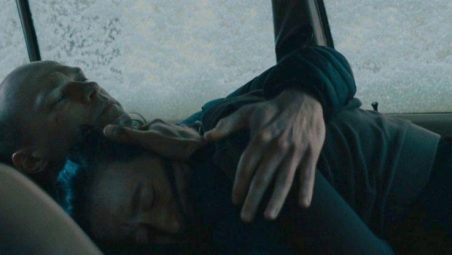
The Florida Project has many similar thematic concerns of poverty and sex work, but it treats these topics with realisim and authenticity and thus does not make them into spectacle but rather a genuine commentary on the american wealth inequality and the struggles of life on the fringes. It is an inherently phenomenological film, as it is “interested in the subjectivity of the observer” (Hammond, 2021) with 6 year old Moonee as the focal point, the spectator sees life through her lens. The diegetic visual world is marked by vibrant colours, ice cream shops and carefree summer days, yet Baker does
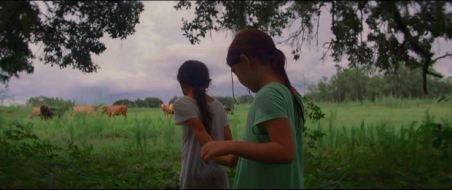
not sacrifice internal meaning for the sake of aesthetics. Throughout the film Moonee is often roaming through the Orlando area with her friends, down long stretches of highway and past endless shop fronts. In the first of these sequences, Moonee teaches Jancey (Valeria Cotto) how to get free ice cream by begging for money. The film form is still vibrant and playful, demonstrating Moonee perception of this as a game, but a customer who does give her money out of pity recognises the sadness in the moment, representing the adult spectator who can also recognise the reality of Moonee’s impoverished lived experience. Interestingly, it cuts to Moonee and her friends sharing one singular ice cream, a clear demonstration of the nuances of wealth inequality. The audience cannot know if the customer was unable to give Moonee more or chose not to because Moonee is only interested in the ice cream, not the issues of wealth disparity and any broader institutional critique. This is an example of how to engage with the phenomenological lived experience of marginalised people, because the elements of marginalisation are always present, it is the choice of how to demonstrate these system injustices that provide depth to the critique. Notably, the film form is often commended by Moonee's movement in these sequences, as the camera moves with her not observantly in a voyeuristic sense, but in a social realist style of filmmaking providing her with a subconscious agency. The colourful landscapes are still marked by the unsafe conditions of Moonee's often unsupervised activity, making no attempt to glamourise her lived experience. The film shows an awareness of this when Bobby (Willem Dafoe), the owner of the motel Moonee lives in, threatens and removes a predatory old man who is lurking around the children of the motel. This demonstrates the film’s ability to represent childhood joy and structural vulnerability simultaneously, exposing the multifaceted lived experience of poverty and exploitation. Phenomenology does not consist “in stringing concepts together but in describing the mingling of consciousness with the world” (Merleau-Ponty, 1964). The many components of The Florida Project’s film form, performance, narrative and thematic concerns all serve to provide a poignant depth to Baker's phenomenological exploration of the lived experience of marginalised existence, which as Merleau-Ponty describes, is the key to “movie material par excellence”.
This carefully constructed phenomenological attention to lived experience is particularly evident in the treatment of Halleys sex work. Unlike the sexualised portrayal of Ani, Baker does not frame Halley through an eroticised gazing camera. She inherently human, and her sex work is not meant to be sexy, her body is not presented as an object of visual pleasure, but as an embodied site of economic survival, revealing how Halley’s labour permeates the everyday reality of her and Moonee’s lives. The film starts with Halley having been fired from a strip club for refusing to have sex with clients which results in her losing her TANF benefits. She struggles to find a stable job and begins to sell perfume to wealthy tourists outside luxury hotels, but harassment from security guards makes this an unsustainable means of supporting herself and Moonee. This tension between economic desperation and maternal protection becomes particularly pronounced in the film’s recurring bathtub sequences during the final act. As Halley begins sex work, the film repeatedly cuts to Moonee playing alone in the bathtub while loud music emanates from the bedroom. The domestic mise-en-scène constructs the bathroom as a temporary space of childhood innocence, with Moonee positioned centrally in the frame as she plays and cleans herself. The loud music simultaneously functions as an audible barrier, separating Moonee’s lived experience from the adult reality of Halley’s work. These elements of the mise-en-scene connote Halleys attempts preserve Moonee’s innocence by physically and psychologically shielding her from the conditions that have forced her into sex work. While Moone is blissfully ignorant to this, the spectator is made increasingly conscious of the economic precarity underlying this seemingly ordinary domestic moment. Baker consequently refuses to either glamorise or wholly condemn Halleys sex work, instead he illustrates its intrusion into the mundane spaces of everyday life, demonstrating how structural poverty becomes embodied within the intimate relationship between mother and daughter. This distinguishes The Florida Project from representations in which sex work becomes a spectacle of female sexuality, instead locating it within the broader structures of economic inequality that shape Halley’s choices. In The Second Sex, Simone
de Beauvoir identifies that women are “the inessential as opposed to the essential. He is the Subject, he is the Absolute—she is the Other.” (Beauvoir, 1949) which becomes paramount in the assessment of Halley and Ani. Both women are ‘othered’ not just for their gender, but also for their social status
and association with sex work. But while Halley’s otherness clearly demonstrates the institutional injustice of women facing intersectional hardship, Ani is simultaneously othered in her experiences and by the film itself. Through the lingering male gaze and her lacking of agency within the plot progression, Ani is sexualised and exploited for a quasi-pornografic depiction of poverty that provides significantly less depth than that of Halley's marginalised and multifaceted lived experience.
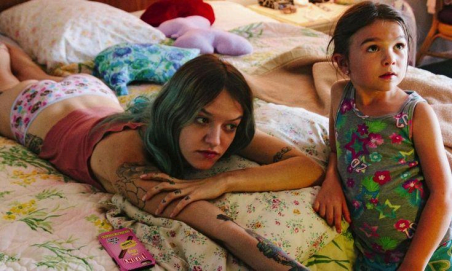
While Baker remains an auteur director, with a distinct visual language and technical competence, Anora does not confidently provide the same depth of interior meaning as The Florida Project does. In both films we see how quickly life can fall apart for marginalised people in the face of economic instability and what stands out the most is the vastly different modes Baker uses to demonstrate this devastating reality. The Florida Project, whilst beautiful and raw, is at no point truly exploitative. Instead Baker provides a contemplative and carefully crafted, phenomenological exploration of his characters and how they navigate their hardships. Nearing its 10 year anniversary, The Florida Project’s purpose feels more relevant and necessary than that of Anora. The Florida Project engages with the concepts of poverty, otherness and the exploitative male gaze, but unlike Anora, it refuses to exploit its characters in the process of exposing these inherent systemic flaws. Ultimately, the popularity of Anora reflects the broader social issues with the modes of cinema and the cultural
mindset of what is considered art; with economic hardship and female sexualisation being used for a surface level social commentary demonstrating how spectacle is prioritised over purpose.
Anora (2024) dir. Sean Baker [Film]. Los Angeles: Neon.
The Florida Project (2017) dir. Sean Baker [Film]. Los Angeles: A24.
Tangerine (2015) dir. Sean Baker [Film] Los Angeles, CA: Magnolia Pictures
Mulvey, L (1975) ‘Visual Pleasure and Narrative Cinema’ in Screen, 16(3), pp. 6–18.
Hammond, M (2021) ‘What is Phenomenology?’. URL: https://warwick.ac.uk/fac/soc/ces/research/current/socialtheory/maps/phenomenology/
de Beauvoir, S. (1953) The Second Sex. Translated by H.M. Parshley. London: Jonathan Cape.